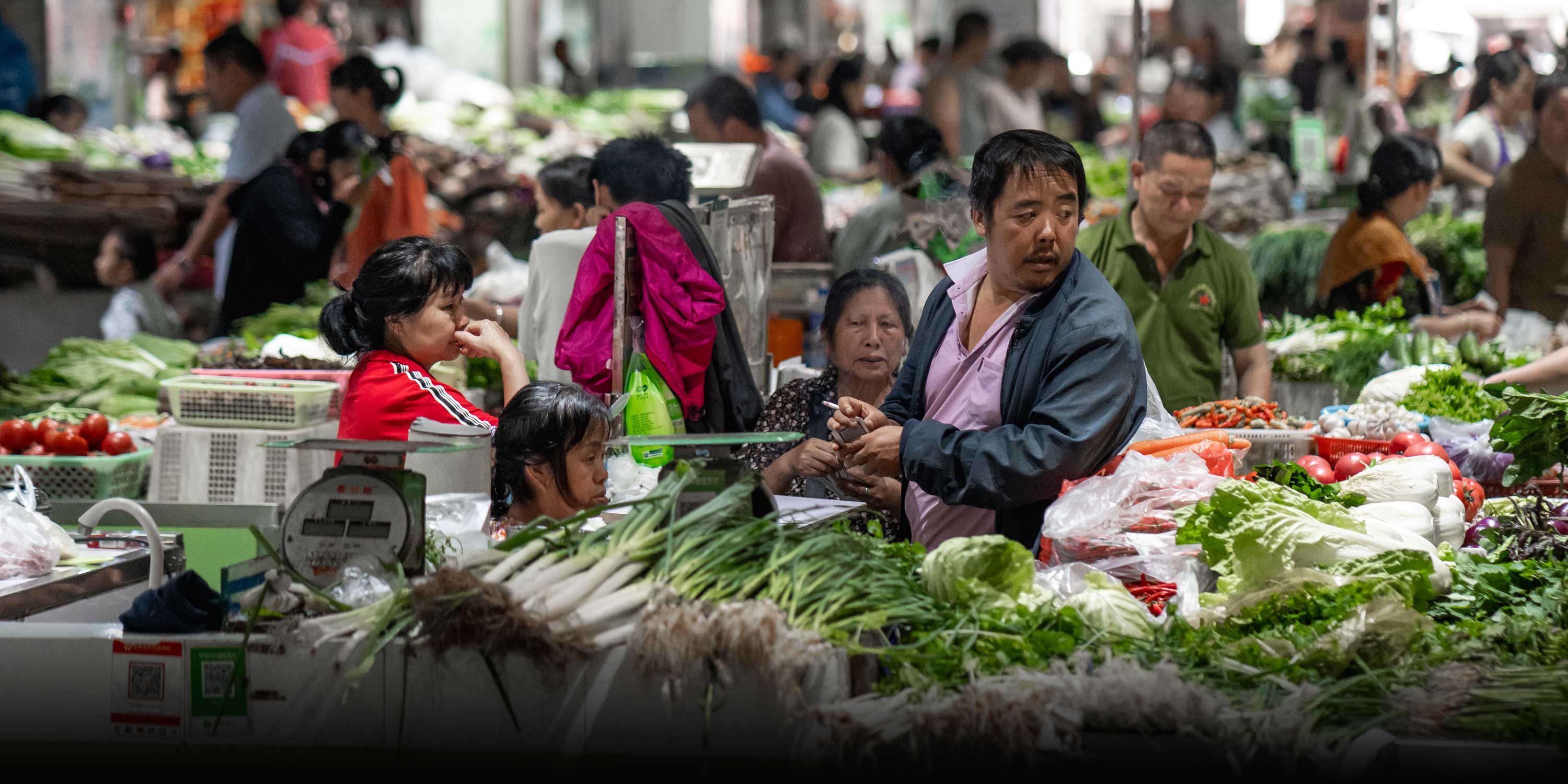
Farmers’ Markets for the Masses: The Key to China’s Vibrant Local Food Culture
Zhong Shuru has been working at a university in the southern Chinese city of Zhuhai for years. But she still regularly drives three hours north to the outskirts of Dongguan City just to stock up on chicken from her mother’s village.
This kind of commitment to fresh local produce is far from unusual in southern China’s Guangdong province, home to just over 125 million people and the birthplace of Cantonese cuisine.
“In Guangdong, we have a saying: Without chicken, there is no feast,” said Zhong, an associate professor of anthropology at Sun Yat-sen University.
The province consumes a whopping 800 million chickens a year, and locals pride themselves on their ability to taste the difference between “good chicken” — free-range birds raised for over 200 days — and the battery-farmed broilers used by most fast-food chains.
This passion for high-quality produce has shaped the region’s entire food supply chain, helping local networks survive even amid the rise of modern supermarket chains and online delivery services.
Even today, city dwellers across Guangdong can easily access fresh meat, seafood, fruits, and vegetables at relatively affordable prices via a dense web of neighborhood food markets.
For Zhong, these markets — often called “wet markets” in English — have long been a source of fascination: They are a relic of the pre-supermarket era, but also a potential antidote to industrial food production.
This point struck Zhong keenly when she began a Ph.D. at Texas A&M University. She quickly realized that such markets simply didn’t exist in much of the United States — unless you count expensive farmers’ markets.
During her time in Texas, Zhong found herself surviving mostly on pizza and pasta dishes to save time — a habit that added “about 10 kilograms” to her weight, she recalled.
That was when she decided to launch a research project into China’s food markets, aiming to understand the role they played in feeding the country.
In the summer of 2016, she began a work placement at a market stall selling Spanish mackerel in China’s southern province of Hainan, where she spent over a year tracing the fish’s journey from the South China Sea to dinner tables across the tropical island.
Over the following decade, she would visit more than 200 markets all over China, writing books including 2025’s “Sustainable Food Consumption in China.”
At the core of her research lies a burning question: Are local markets destined to decline in an era that prizes convenience, or could they help promote a resurgence in sustainable eating habits?
A misunderstood market
But first, it’s necessary to clear up a few common misconceptions. For years, the term “wet market” has fueled all sorts of prejudices in the English-speaking world, where negative stereotypes about Chinese eating habits have a long history.
Zhong specifically recalls a member of her Ph.D. committee in Texas frowning as she introduced her research subject. “What are wet markets?” the person asked. “Sounds disgusting.”
It didn’t help that some markets in China were involved in the wildlife trade until China outlawed the trade in 2020, with the practice allegedly playing a role in spreading pathogens such as the coronavirus that caused the 2002–2003 SARS epidemic.
But in reality, the term wet market encompasses a huge variety of venues selling different kinds of fresh produce. Most do not sell livestock, let alone exotic animals.
The Singapore government coined the term in the 1970s, wanting to distinguish between markets selling “dry” preserved goods and “wet” produce such as fresh meat and vegetables, according to Zhong.
The term likely began being applied to Chinese food markets in the 1980s and 1990s — a period when China leaned on Singapore for guidance as it rapidly reformed its economy and integrated into the global market.
And while wet markets are now associated with China, their origins in the country lie partly with Western businessmen living in Shanghai and Guangzhou during the 19th century.
Before then, food in China tended to be distributed through open-air markets known as ji, which towns and villages across the country often held weekly.
As cities such as Shanghai and Guangzhou grew rapidly in the 1800s, farmers and vendors flocked in to set up informal open-air markets to serve their swelling populations.
In 1864, a British businessman and a French priest teamed up to open Shanghai’s first indoor food market. Though that venture was short-lived, it pioneered a business model later adopted by other businesses and government bodies.
That eventually led to the establishment of large-scale facilities such as Shanghai’s Sanjiaodi Market — a three-story building with vendors selling vegetables, meat, and snacks on different floors every day.
But the nationwide boom of such markets did not begin until the 1980s, when China embarked on economic reforms that legitimized entrepreneurship and turbocharged urbanization. Street vendors would later gain legal status as “self-employed traders,” allowing them to open stalls in formal permanent markets.
The push to build more food markets even gained political significance as new residents flooded into the cities. In 1988, China launched the cailanzi (literally “food basket”) project, which tasked local officials with ensuring a stable supply of affordable and high-quality meat, vegetables, fruit, and dairy products.
Mayors across China were pushed to expand the food supply, improve logistics, and regulate trade, cementing markets as a vital part of a city’s infrastructure. In 2013, Shanghai set a goal of doubling the city’s number of “standardized food markets” to 1,500 by 2020, to ensure it could feed a population expected to reach “nearly 30 million” residents.
Modern temptations
But these neighborhood markets have since come under pressure amid the rapid expansion of supermarket chains and later online delivery services.
In 1995, the French retail giant Carrefour became the first global supermarket chain to enter the Chinese mainland, as a “supermarket revolution” swept across the Global South.
Supermarkets quickly won over millions of Chinese consumers with their promise of greater convenience, food safety standards, and — occasionally — lower prices.
By 2019, China had nearly 27,000 supermarkets, some built on the sites of former local markets.
Much was lost along the way. By operating large-scale, standardized supply chains, the businesses effectively severed the link between swathes of shoppers and locally produced food.
Yet, many pockets of Chinese society refused to buy the narrative that freshness could be acquired with a click.
In Hainan, Zhong found that some locals still didn’t have a refrigerator at home — not because they couldn’t afford one, but because of local beliefs that livestock must be consumed within hours of being slaughtered.
Locals who “know their food” would visit markets twice a day to ensure every meal was prepared with the freshest ingredients — a stark contrast to Zhong’s experience in Texas, where she drove to a supermarket to stock up once a week.
Seafood connoisseurs were another group who invested in the freshest local ingredients. In Hainan and other coastal regions, one of the most sought-after products is xiao haixian — or “small seafood” — an umbrella term for a variety of small catches that even locals often couldn’t identify.
They are fished in coastal waters on the day of sale, often by small boats without onboard freezers. The lack of cold storage was a badge of honor for many fishers — a guarantee that their catch had come directly from the sea that morning.
Zhong had never seen xiao haixian stocked at a food market near her Guangdong home, until one morning she saw fish vendors already packing up at 6 a.m. — just hours after the small fishing boats had returned to the dock nearby.
She found a similar appetite for freshness nearly 1,500 kilometers away in Suzhou, a historic city near Lake Tai in eastern China renowned for its refined cuisine.
There, she met a vendor specializing in seasonal food: freshwater mussels and snails in spring, soft-shelled turtles and eels in summer. The highlight of the year was autumn, when markets filled with traders selling jitoumi — seeds from a local water plant used in sweet soups.
It is a delicate ingredient that requires hours of labor to clean and hand-shell, and its sales window is brief: By late autumn, it has disappeared from local markets, just as hairy crabs come into season and dominate the stalls in this part of China for just a few weeks each year.
With their focus on stable output, mechanical processing and long-distance supply chains, products like xiao haixian and jitoumi simply do not fit the supermarket business model.
But thanks to local food markets, these local treasures are still widely available — and their popularity, in turn, has helped traditional markets survive even amid the digital shopping era.
“China is fortunate to have a robust local food culture,” Zhong said.
A web of relationships
Another key takeaway from Zhong’s tour across more than 50 Chinese cities is that food markets have not just shaped tastes, but also strengthened people’s bonds with their land.
In Guiyang, capital of southwestern China’s Guizhou province, she observed how vendors used more than 20 different methods to process tofu. In the northwestern city of Yining, she learned how nomadic communities had developed a unique relationship with their cattle and sheep.
Perhaps the most dramatic case was the “snowbird” community in Hainan.
Every winter, an estimated 1.5 million people from northern China — mostly retirees — move to the tropical island province to escape the freezing weather. There, they must adapt to a way of life starkly different from what they are used to in their hometowns near the Russian and North Korean borders.
As Zhong discovered, local markets often become a key venue where “snowbirds” learn to navigate the island’s dialects, fish names, and love of bargaining. She recalled spending time with a woman called Aunt Mei, a 60-something who moves to Hainan with her husband for six months each year.
Mei was not a fan of saltwater fish back in northern China, but she was captivated by the colorful varieties at the market and decided to give them a taste. She tried mincing Spanish mackerel and mixing it with ground pork to make dumplings — the staple food in her hometown.
The fish dumplings struck the couple as unforgettably “fresh,” sparking Mei’s passion for saltwater fish. After the local market closed, she teamed up with several other “snowbirds” to purchase fish directly at the docks.
Drawing on geographer David Seamon’s term, Zhong likens ordinary people’s experience of food markets to a “place-ballet”: By frequenting these markets, people develop a life rhythm in sync with their place, deepening their understanding of local food, culture, and communities. For “snowbirds” like Mei, learning this “place-ballet” helps them adapt to life on their new island.
For locals, relationships built around the market can also help them weather difficult times. In Shanghai, Zhong met a fish vendor who had kept a stall for three decades and maintained contact information for over 4,000 customers.
During the Covid-19 pandemic, he repeatedly received phone calls from customers — especially older clients — who couldn’t access markets. In response, the vendor delivered more than 300 orders per day to his customers’ homes, to ensure they could still get the groceries they needed.
Every bite matters
Yet despite all their advantages, food markets across China face daunting challenges.
Many are losing customers to supermarkets and, increasingly, online retailers. Meanwhile, mismanagement persists, as many markets have shifted from state control to neighborhoods, private companies, and individual investors since the 1990s.
In many cases, the privatizations boosted efficiency but also led to underinvestment in drainage, ventilation, and waste management, damaging customer experiences and sparking conflicts between vendors and venue managers.
It was no coincidence that the blockbuster Chinese crime drama “The Knockout,” released in 2023, centered on a clash between a fish stall owner and rent-seeking managers at a Cantonese market.
“To run a fresh food market, you shouldn’t follow the mindset of a landlord who just collects rent,” Zhong said. “Instead, you should treat vendors as your most important asset and support them.”
Zhong tries to maintain a “neutral perspective” toward the modern food industry. Supermarkets are not all bad; their sophisticated supply chains allow Shanghai residents to buy mushrooms grown more than 2,000 kilometers away in China’s southwestern Yunnan province, or tropical fruits from across Southeast Asia. She also understands why exhausted young workers order food online rather than spending hours buying groceries at their local market.
But she also worries about the hidden costs of such convenience. Supermarkets and e-commerce platforms often trumpet their “direct sourcing, no middlemen” business model in China, telling consumers they can provide unbeatable value.
What they don’t mention is their disproportionate bargaining power over farmers. During a recent research trip to Guangdong, Zhong found some growers were reluctant to work with platforms even when offered large orders, fearing they would have to accept massive discounts, customize production, and become trapped in a dependent relationship with the conglomerates.
Local flavors can disappear, too. Standardized retailing favors food suited for mass production and long-distance transportation. True local flavors, however, have to be found near the field. Cantonese people can only buy their favorite variety of chicken at a local market, and to truly taste maolaguo, a wild tomato, one must visit Guizhou in person.
According to Zhong, to preserve the flexibility and diversity of China’s food markets, both governments and consumers need to shift their mindsets.
In recent years, some markets have undergone refurbishment to look sleek and appeal to young customers, a move criticized for gentrifying neighborhoods. “Not every market needs cafés and flower shops,” Zhong cautioned.
Instead, market managers and local governments should focus on addressing vendors’ and consumers’ actual needs: better lighting, waste management, and parking. Ultimately, a market won’t be sustainable if it is not embedded in local connections, according to Zhong.
As for consumers, Zhong encourages them to try things out: accepting that farmers’ markets, like e-commerce apps, take time to navigate. She recalled that during her first days of fieldwork at the Hainanese market, she found bargaining in the local dialect unsettling. Now, she can confidently explore a new market and occasionally surprise her family with knowledge about local products.
“As consumers, we can vote with our mouths,” Zhong said. “Every bite matters.”
(Header image: A farmers’ market in Pu’er, Yunnan province, 2024. Courtesy of Graeme Kennedy)